HX-2404PE
24+2+2-Port 100M PoE Switch
- Ports
- 24
- Budget
- 400W
Product category
Quick answer
A 24-port PoE switch powers 24 cameras only if they are 6 W domes — the budget, not the port count, sets the real number. With 400 W that is roughly 13–17 W per port depending on the reserve kept, and with 300 W roughly 10–12 W. Both budgets are pooled: a few 25 W PTZ heads decide the loading long before the 24th port is used.
Twenty-four powered ports is the largest single unit in this range, and the one where the budget arithmetic decides the product. Twenty-four ports loaded at the 802.3at limit is 720 W — far beyond any unit here, which is why the budget line matters more than the port count.
The 4 models in this size run 300–400 W, in 100M and gigabit versions, with uplink arrangements for the run back to the core.
Every figure below comes from the current product data. Click a model to open its full specification page.
| Model | Uplink Ports | Power | Input | VLAN | Size (L×W×H) |
|---|---|---|---|---|---|
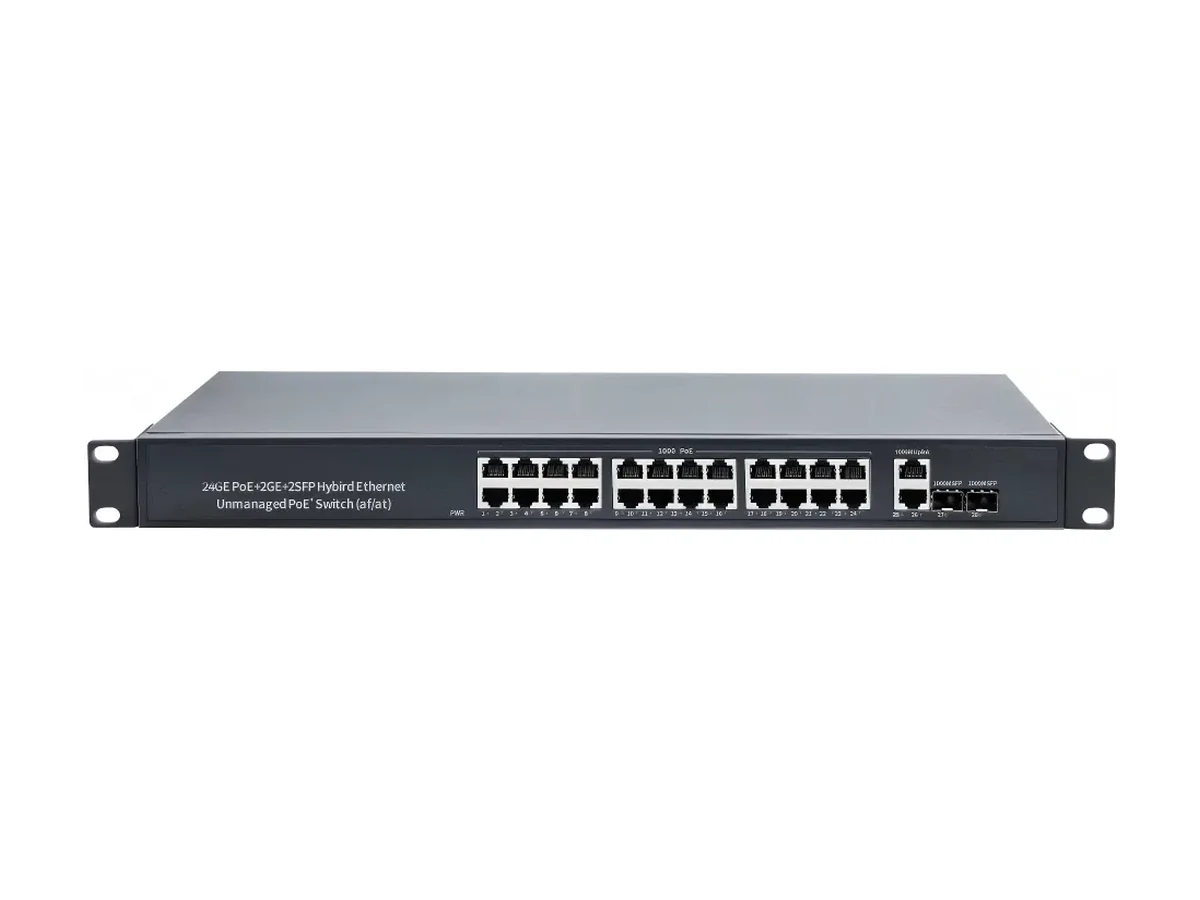
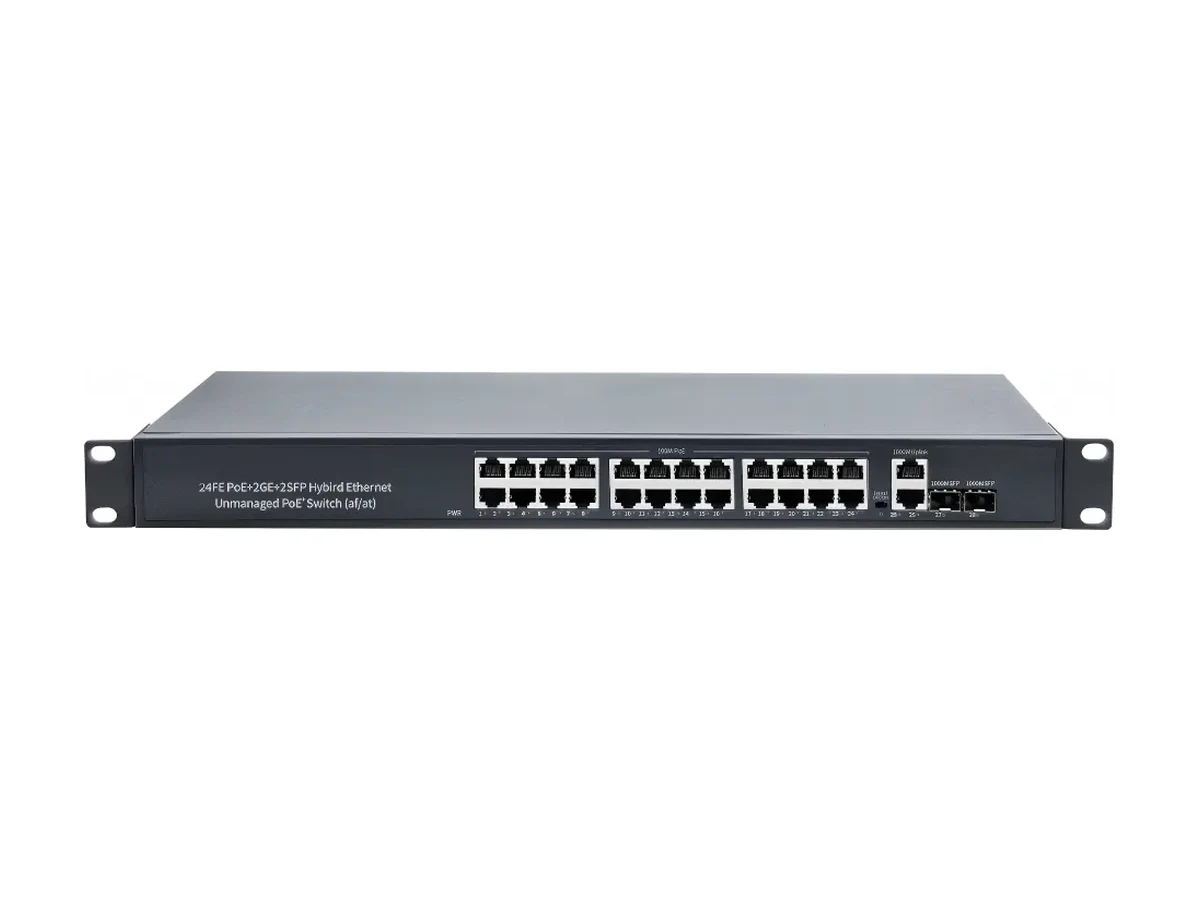
| HX-2404PE24+2+2-Port 100M PoE Switch | 2 × 10/100/1000Base-T(X) adaptive Ethernet ports 2 × 1000Base-X SFP fiber port | 400W | AC100-240V 50/60Hz | Yes | 486×190×44mm |
| HX-2404PEG24+2+2-Port Gigabit PoE Switch | 2 × 10/100/1000Base-T(X) adaptive Ethernet ports 2 × 1000Base-X SFP fiber port | 400W | AC100-240V 50/60Hz | No | 486×190×44mm |
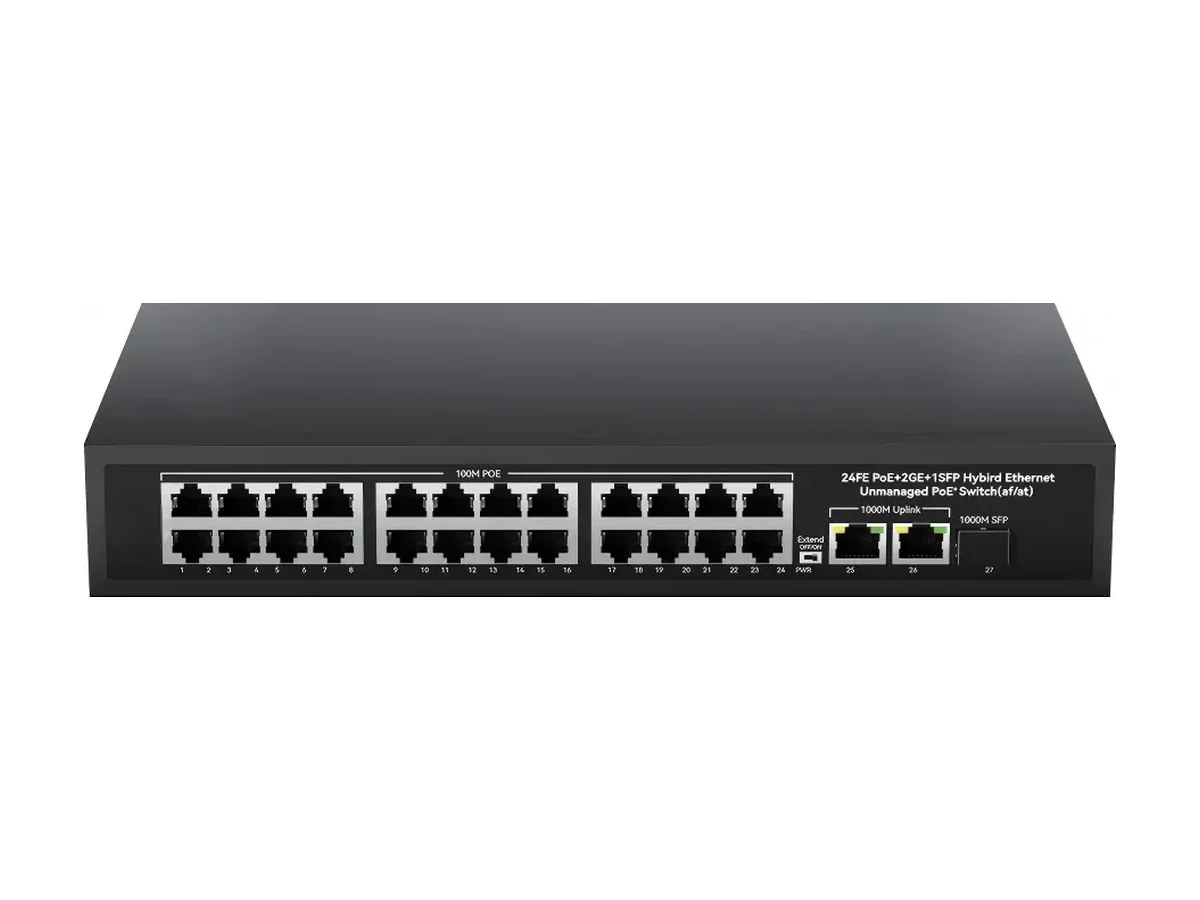
| HX-X2403PE24+2+1-Port 100M PoE Switch | 2 × 10/100/1000Base-T(X) adaptive Ethernet ports 1 × 1000Base-X SFP fiber port | 300W | AC100-240V 50/60Hz | Yes | 310×180×45mm |
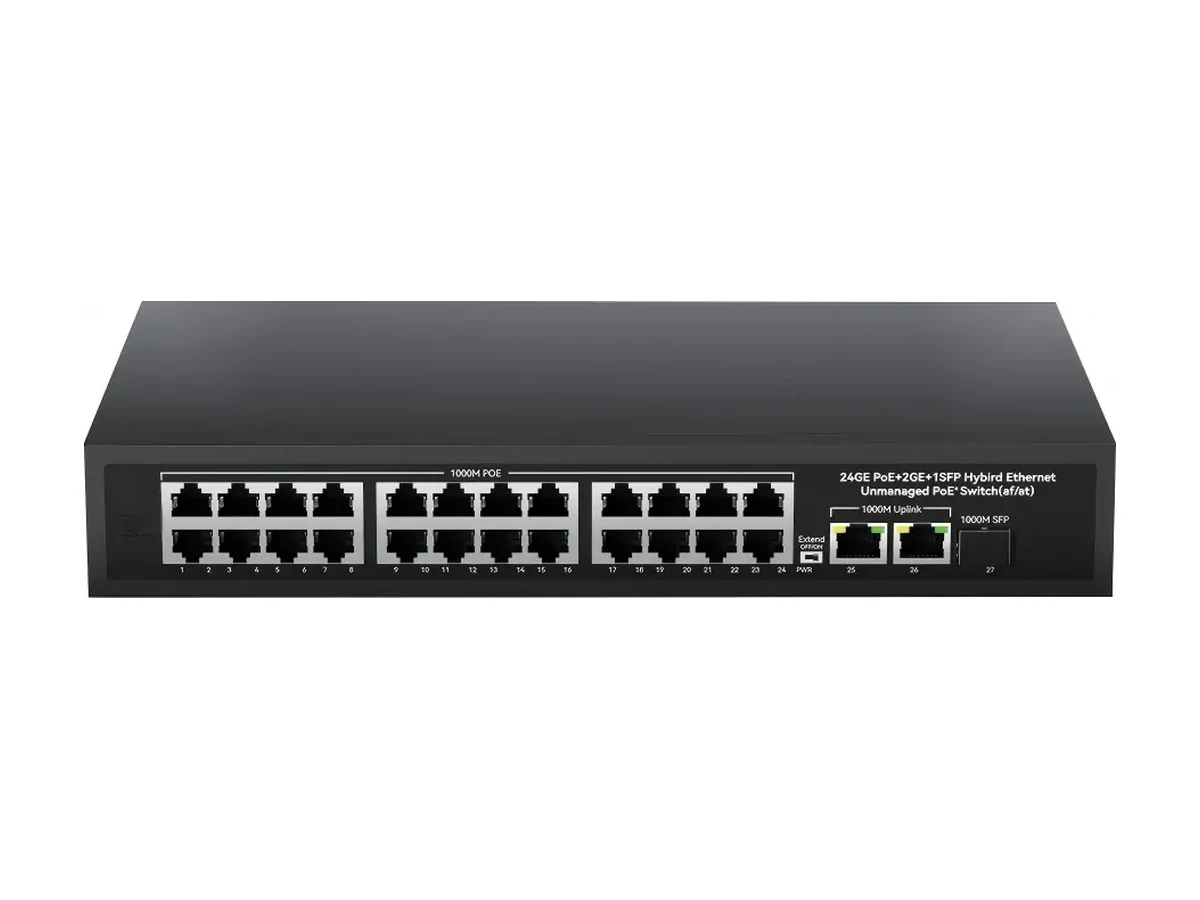
| HX-X2403PEG24+2+1-Port Gigabit PoE Switch | 2 × 10/100/1000Base-T(X) adaptive Ethernet ports 1 × 1000Base-X SFP fiber port | 300W | AC100-240V 50/60Hz | No | 310×180×45mm |
Calculated from the published budget of each model with a 20% reserve kept for PoE start-up surge, IR load at night and ageing. The figure is capped by the powered-port count, so it never promises more devices than there are ports. Budgets are pooled — one 25 W PTZ takes what several 6 W domes would.
| Model | PoE ports | Budget | Fixed dome6 W label | Wireless AP8 W label | 802.3af device15.4 W class | PTZ / 802.3at device25.4 W class |
|---|---|---|---|---|---|---|
| HX-X2403PE24+2+1-Port 100M PoE Switch | 24 | 300 W | 24 | 24 | 15 | 9 |
| HX-X2403PEG24+2+1-Port Gigabit PoE Switch | 24 | 300 W | 24 | 24 | 15 | 9 |
| HX-2404PE24+2+2-Port 100M PoE Switch | 24 | 400 W | 24 | 24 | 20 | 12 |
| HX-2404PEG24+2+2-Port Gigabit PoE Switch | 24 | 400 W | 24 | 24 | 20 | 12 |
Method: floor(budget × 0.8 ÷ device draw), capped at the powered-port count.Run your own numbers in the PoE budget calculator →
The four models are not three budget tiers of one product — they are two chassis sizes crossed with two access speeds. That makes the choice short: pick the chassis by budget and cabinet space, then pick access speed by what the cameras and the NVR need.
| Site condition | Model | Why |
|---|---|---|
| 24 cameras, mixed domes and PTZ, full-width rack | HX-2404PEG | 400 W budget, 24 gigabit access ports, 24+2+2 with two SFP slots, 486 mm rack width |
| Same load, but camera ports must be isolated at layer 2 | HX-2404PE | 400 W and two SFP slots on 100M access ports, with the panel VLAN isolation switch fitted |
| Mostly fixed domes on 100M, smaller wall cabinet | HX-X2403PE | 300 W budget, 310 mm chassis, 24+2+1 with one SFP slot, VLAN isolation switch fitted |
| Mostly fixed domes, gigabit access, smaller cabinet | HX-X2403PEG | 300 W budget, gigabit access, 310 mm chassis, 24+2+1 with one SFP slot |
If the site is close to the 300 W limit, buy the 400 W model: the difference is cheaper than a second switch when a fourth PTZ is added two years later. Run your camera count and draw through the PoE budget calculator to see which of the four covers it with the reserve kept.
Every model in this range is unmanaged. It stands up, powers what is plugged into it and forwards traffic; the panel switch on some models isolates the camera ports from the uplink at layer 2, which is a wiring convenience rather than a management interface.
That covers most CCTV and AP installations, because segmentation is normally done at the core switch or the NVR. It does not cover an IT department that expects a web interface, per-port VLAN assignment, SNMP polling or a ring protocol — for those, the managed switch belongs upstream and this unit stays the powered edge.
The longer comparison, including what each management feature costs in a camera network, is in managed vs unmanaged PoE switch.
One unit is cheaper, needs one mains feed and one uplink, and gives a single configuration to document. Two 16-port units split the failure domain: a dead switch takes out half the floor rather than all of it, and camera runs are shorter if the cameras are physically in two places.
The deciding factor is usually uptime policy, not price. Where the site has an SLA that treats one recorder outage as an incident, the second unit pays for itself the first time a power supply fails. Where the cameras cover a yard or a shop floor and a day of downtime is tolerable, one 24-port unit is the sensible purchase.
Both approaches land in the same range — see the 16-port models for the split design and the capacity table above for the budget arithmetic on each chassis.
Depends on the mix, not the count. With 400 W, fixed domes at 6 W fit all 24 ports with headroom and 25 W PTZ heads are limited to about twelve; with 300 W the same PTZ load fits nine. Add the labels up at peak and keep 20% spare — the capacity table above does that per model.
One unit is cheaper and simpler. Two units split the failure domain and shorten cable runs if the cameras are in two places — which usually matters more than the price difference.
The switches in this range deliver the 802.3af/at power classes on the (1/2)+, (3/6)- pair arrangement, with budgets up to 400 W per unit. A 60 W or 90 W bt device is powered by a bt injector — the 60 W and 90 W standard injectors in the range are specified for 802.3af/at/bt — rather than by the switch port. Tell us the device and the port count and we will say which combination works.
Access speed and the VLAN switch. HX-2404PE has 100M access ports and the panel VLAN isolation switch fitted; HX-2404PEG has 10/100/1000Base-T access ports and no VLAN switch. Both are 24+2+2 with a 400 W budget and two 1000Base-X SFP slots.
Budget for the full supply at peak: a 24-port unit loaded to 400 W of PoE is dissipating most of that as heat inside the cabinet, plus its own conversion losses. Treat cabinet ventilation as part of the installation, not an afterthought — an enclosed 400 W unit on a hot day is the usual cause of unexplained reboots.
The 400 W models are 486 × 190 × 44 mm, which is 19-inch rack width in a 1U form factor with the panel handles; the 300 W models are 310 × 180 × 45 mm and fit a wall cabinet. Mounting hardware is quoted with the order.
The budget does not change — it is a property of the power supply, not of the port count. Using twelve ports leaves more headroom per port, so it is safe to put a 25 W PTZ on each of them; loading all twenty-four at 25 W is what breaks a 300 W or 400 W unit.
The switch will not deliver more than its supply can produce: devices at the end of the priority order are refused power at start-up or drop out under load, which on a camera site shows up as cameras that reboot at dusk when IR and heaters come on. Size to the sum of the labels at peak, with the reserve.
20 models
Factory-direct PoE switches — 20 models: {ports} ports, 100M and gigabit, SFP uplinks, {budget} budg…
View category16 models
Factory-direct surge protectors — 16 models: network, PoE, AC power and data-line, In 2.5-10 kA, Ima…
View category4 models
Factory-direct 16-port PoE switches: 4 models, 100M and gigabit access, {budget} budgets, 16+2+1 wit…
View category